Showing posts with label sustainability. Show all posts

Sunday, 5 September 2010

Fuel cells and hydrogen storage

From previous ramblings + Bill's speech - I think that a commercial approach to solving the problem is the only way to go. Awareness raising etc is of course necessary - but the world works around money - so making a successful commercial venture that helps solve the problem is a clear winner.

Next question is what is the venture?

I think energy storage is a strong candidate. e.g. electrolysis of hydrogen and then recombination in a fuel cell or other such technologies.

Two reasons:
1. Many renewable energy sources are non-continuous. based on current planning - it doesn't really work if 20% of the UK's energy is generated by wind (for instance) as there has to be conventional back up in case of windless days
2. The motor vehicle problem - bio fuels can't really work on world wide scales - so electric cars seem the obvious solution. Next issue is how to store the energy.

I've not done copious research - but I know battery storage of electricity is a no-go. Hydrogen does seem feasible. Fuel cells more efficient than burning H2.

Maybe micro generation is the way. e.g. My villages build x windmills. Link them to 1 small electrolysis plant (already available). Generate H2. Store locally. Car with H2 tank and fuel cell (already available). My question is - is it really scalable? Use fuel cells as smart batteries for homes and cars. Reduce waste and consumption. Helps with solar generation too - export liquid H2?

People are already doing this kind of thing - so not sure where we fit in - but ...

I'd really love to see a small scale 100% sustainable community set up. To prove it can be done without simply going to subsistence living. Then scale it.

Another big thing. The switch in attitude from consumerism to sustainability. Why does a car have to last only 5 years. It is short termist. No reason a more expensive car could not be made that lasts pretty much indefintiely - especially if electric. I have heard someone suggest that a lease model for end users would hide the upfront costs and if car companies owned the cars there would be incentive to make them maintainable (upholstry change after 5 years etc). Side effect it would get people to think about wasted journeys. Today you shell out tons for a car - then trips seem cheap compared to trains. Plus the more you use the car the cheaper it is. Go for a pay as you go method - and that doesn't happen...

Saturday, 7 August 2010

Terrapower - a possible solution?

I've just been pointed to a TED talk by Bill Gates on a possible solution to the global warming problem. See http://www.ted.com/talks/bill_gates.html. Its well worth a look as it sets out the problem very clearly. TED talks are great by the way - type TED into youtube. The amount of CO2 generated (and hence amount of global warming that will occur) is proportional to:
  • The number of people on the planet
  • The amount of services (light, heat, transport etc) each person uses
  • How efficient each of these services is (how much energy each one requires)
  • How much CO2 is generated per unit of energy

    As Bill puts it - the first 3 items will never be zero. The only way to stop emitting CO2 into the atmosphere (from human burning of fossil fuels) is to go after the fourth point. Hence you have the drive for renewable energy.

    Clearly this requirement is perfectly aligned with the higher level sustainability requirements - although note having renewable energy does not mean we have a totally sustainable way of life (e.g. think about land usage pressures, threats to biodiversity etc).

    So how do we get sustainable energy for the planet. Well I suppose that's the biggy. Bill is urging us to look for as many solutions as possible. He favours the high density energy production (e.g. Terrapower) as opposed to diffuse production (wind, solar, biofuels) just because it seems more economically viable. Diffuse sources gobble up land. On the plus side they don't require as much distribution, but then they do not give an uninterpretable supply. I'd tend to agree - high density solutions seem more realistic without subsidy. If it is economically viable - market forces will make it happen. If not - it requires sheer will power and political will power at that  - making it much less likely to happen.

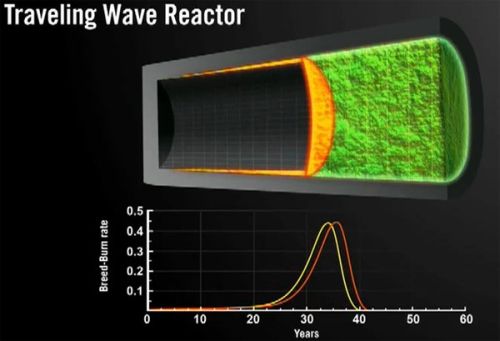
    Terrapower (not maybe the best name?) - also called a travelling wave reactor - is the conversion of Uranium 238 to energy. Uranium 238 is 96% of enriched uranium. The uranium 235 gets "burnt" in the reactor to create nuclear power. The 238 is not "burned" and becomes the waste. So not only is this very efficient - it runs off current nuclear waste! Sounds too good to be true. The main downer on it is that is hasn't been demonstrated yet - so who knows - maybe that is the solution.

    Bill's other point is to back as many horses as possible as Terrapower may not work out. If 50 years is the time horizon where we must have a solution - else "something very bad" - then it is clearly the 1st problem to solve to get to a fully sustainable system